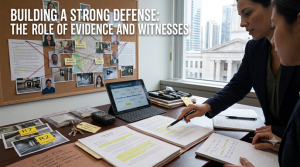
In any court case—whether it’s a high-stakes criminal trial or a civil dispute—a strong defense isn’t built on compelling stories alone. It is anchored in verifiable facts. The foundation of any solid legal strategy relies on two crucial pillars: evidence and witnesses. Together, these elements transform claims into persuasive arguments, helping judges and juries see what truly happened rather than relying on speculation. The Power of Evidence: Concrete Proof Evidence is any material presented in court to prove or disprove a point in question. In building a defense, evidence serves to establish a clear timeline, verify the defendant’s account, or highlight flaws in the prosecution or opposing party’s case. Legal evidence generally falls into a few key categories:
- Physical Evidence: Tangible objects connected to the event, such as damaged property, personal items, or clothing.
- Documentary Evidence: Written or recorded records, including contracts, emails, text messages, financial statements, or medical records that corroborate the timeline.
- Digital Evidence: Modern cases heavily rely on electronic data, such as GPS tracking logs, surveillance camera footage, phone records, or social media activity.
Defense teams typically rely on two types of witnesses:
- Fact Witnesses (Eyewitnesses): Individuals who directly observed relevant events—such as seeing an incident occur, hearing a conversation, or verifying the defendant’s whereabouts (an alibi witness). Their testimony helps reconstruct the sequence of events.
- Expert Witnesses: Professionals with specialized knowledge, skills, or training who can analyze complex aspects of a case. For instance, a forensic accountant might explain financial records, a medical examiner could detail injury patterns, or a digital forensics specialist might verify the authenticity of electronic data. Expert witnesses help demystify technical details for the court.
Connecting Evidence and Witnesses
The real strength of a legal defense comes from how evidence and witnesses complement one another. A witness’s memory can fade or be challenged under cross-examination, but physical evidence like a time-stamped security video can back up their story. Conversely, a document might be confusing on its own until an expert witness walks the court through what it actually means.
Ultimately, building a strong defense is a methodical process. By gathering admissible evidence and presenting credible witnesses, a defense team creates a cohesive, factual narrative designed to protect rights, challenge assumptions, and ensure a fair outcome.